


15 Years of Litecoin & 15 Milestones
Only two crypto have achieved fifteen years of activity: Bitcoin, and now Litecoin.
Since Litecoin launched on 13 October 2011, Coinmarketcap has estimated more than 60 million cryptocurrencies have appeared. Among former ‘Top 100’ projects, Cryptorank’s research shows only 71.9% still exist, and even fewer remain active. Meanwhile, Litecoin has never left the leaderboard. Ever. While market cap ranking is one way to measure Litecoin’s success, there’s so much more to the project’s 15 year history. And this piece celebrates 15 milestones that have had a profound impact on the space, the project, and Litecoin’s users.
Happy 15 Years, Litecoin. Here’s to many more!
1. 2011: Litecoin's fair launch
Charlie Lee, aka coblee, announced Litecoin on BitcoinTalk in October 2011.
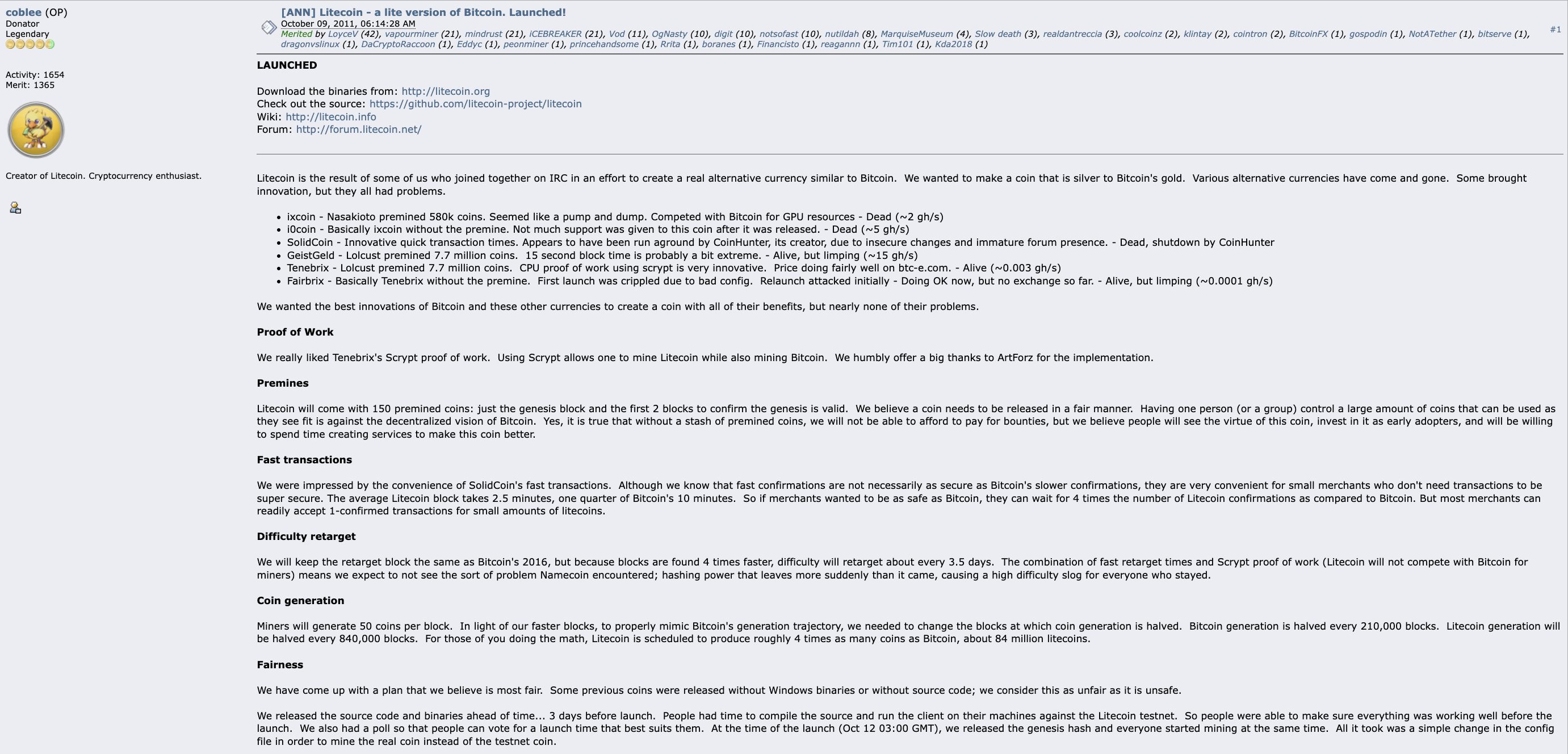
Earlier that month Lee had settled on the project’s positioning as a ‘lite’ version of Bitcoin, and quickly landed on a suitable name: Litecoin. On 4th October 2011, Lee registered five domains - including Litecoin.org and Litecoin.com - on CrazyDomains for $38.85. Eventual Ethereum co-creator, Vitalik Buterin, wasn’t a fan of the name, though.

Unlike other projects to that point, the intent was for Litecoin’s launch to be as fair as possible. With that in mind, the source code and binaries were released four days before launch so anyone could download them, compile the software, and get set up in advance. Even Litecoin’s go-live date/time was voted on by the community. With 42.9% of the 91 voters opting for 03:00 GMT on Thursday 13 October 2011.
To avoid speculation of a pre-mine ahead of public release, Lee took a leaf from Satoshi’s playbook and placed a timely headline into the Coinbase data of Litecoin’s genesis block.
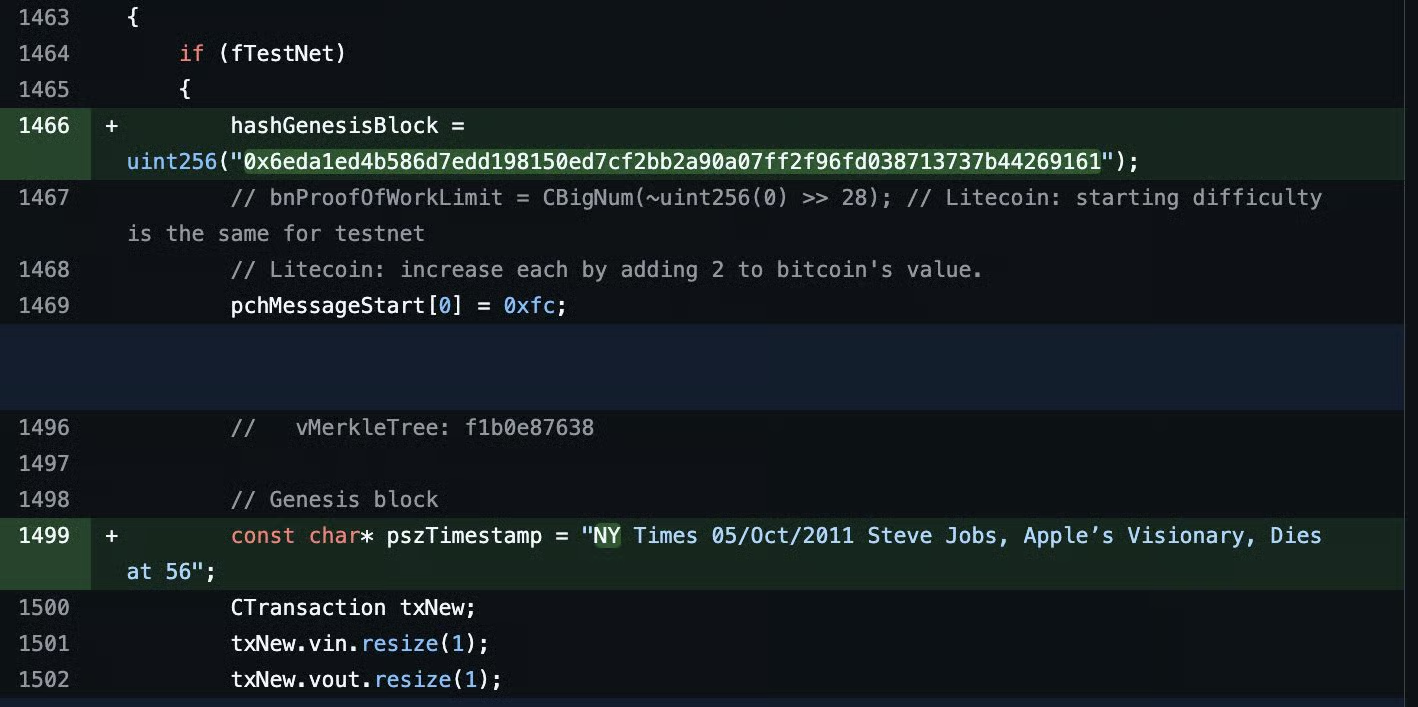
No question, Litecoin had pulled off the fairest crypto launch to that point. Maybe ever? Think about it: of the 60 million cryptocurrencies, how many launched without an ICO, VC-backing, founder stash or massive pre-mine? How many projects let the community decide when to launch, or released candidates ahead of time to ensure equal mining opportunity from the jump?
Litecoin had the fairest, most decentralized and transparent launch in history.
2014: Litecoin and Dogecoin begin merged mining
In December 2013, Dogecoin launched as a fork of Litecoin. Almost immediately, Dogecoin faced network security issues due to shallow, fluctuating hashrate. By mid-2014, Charlie Lee proposed a potential solution. One that would not just strengthen Dogecoin, but Litecoin too. So Lee reached out to Doge’s community on reddit to outline the concept and benefits of LTC/DOGE merged mining:
Fortunately for all, Lee’s proposal was well-received by the Doge community, and Dogecoin adopted AuxPoW on 11th September 2014. Chains didn’t merge. Project rules and block histories remained independent. So what changed? Miners could now reuse the same proof-of-work to help secure both Dogecoin and Litecoin networks.
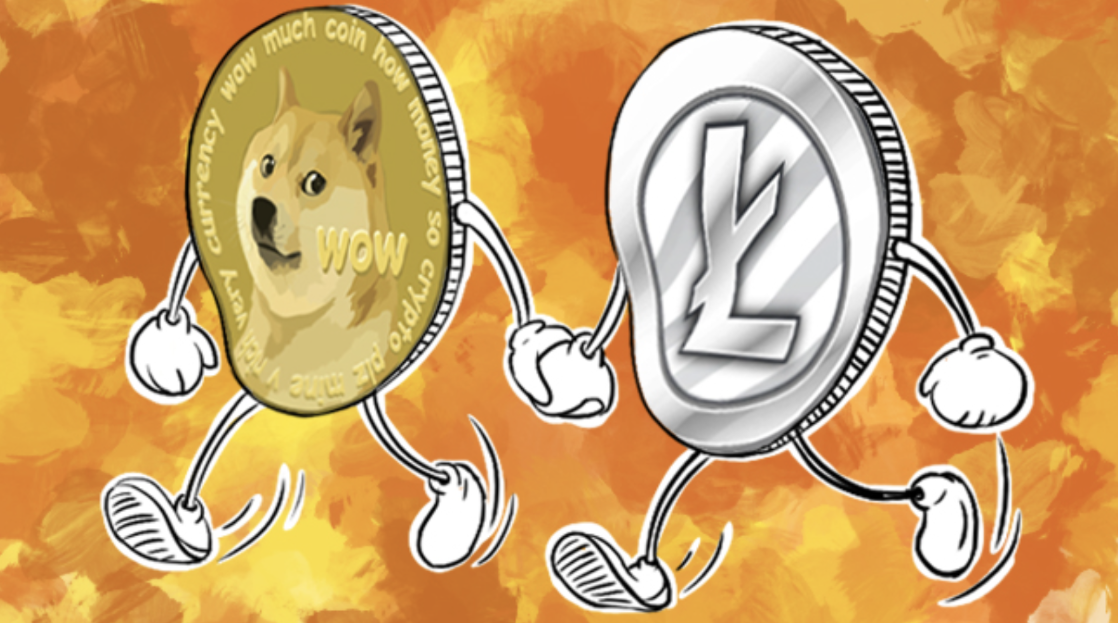
If this merged-mining milestone never happened would we still have Doge? Or Litecoin!? Thankfully common sense prevailed over tribalism, and both projects are thriving more than a decade later.
3. 2015–2023: Three halvings. No committee required.
Litecoin is programmed to experience a halving roughly every four years.
On 2nd August 2023 Litecoin’s third successful halving saw miner rewards reduced from 12.5 Litecoin to 6.25 Litecoin. So why celebrate miners getting their reward cut in half? Put simply, each Litecoin halving acts as a self-deflationary mechanism. Ensuring that Litecoin’s fixed supply of 84 million becomes more scarce over time by halving the amount of new coins introduced into circulation approx. every four years.
The concept can be challenging to get your head around. We made a short visual explainer on halvings and their importance in the ongoing success of Litecoin and other proof-of-work (PoW) projects. It’s short and great if you’re a visual learner:
Litecoin’s fourth halving will take place in late July 2027, reducing coin issuance to 3.125 LTC per block mined. And while Litecoin Foundation was established to help maintain and grow Litecoin, the non-profit has no control over block halvings. Every facet of Litecoin’s future coin issuance - including halving dates / block height, and reward amounts - was written into the codebase fifteen years ago. Back in early October, 2011. Which is mind-blowing, given these halvings will continue until 2142. At which point Litecoin’s entire fixed supply of 84 million will be issued and circulating.
4. 2017: The Litecoin Foundation is incorporated
In 2017, Litecoin Foundation was formally incorporated in Singapore. And in mid-2022, the non-profit achieved 501(c)(3) status - allowing U.S citizens to make tax-deductible contributions.
From the outset, the Foundation’s mission was clear: to advance Litecoin awareness, adoption, security and development. Nearly a decade later, Litecoin Foundation’s mission remains unchanged. And its leadership, community and volunteers are more dedicated, effective and passionate than ever before.
To learn more about Litecoin Foundation, how to donate, join the team or volunteer, please visit: https://litecoin.com/litecoin-foundation.
Your support ensures the continued growth, decentralization and development of the Litecoin network. Thank you!
5. 2017: Coinbase adds Litecoin
In May 2013, Charlie Lee sent an email to support@coinbase.com to see if they’d "be interested in supporting Litecoin”. Coinbase’s first employee, Olaf Carlson-Wee, responded 48 hours later asking for Lee’s phone number. And the rest is history…
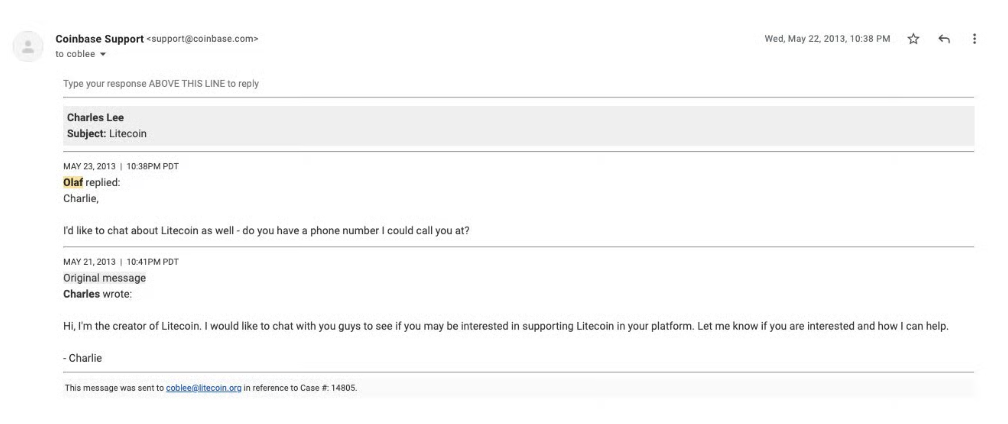
Not so fast.
While Lee initiated the chat, it was actually Coinbase who had a proposition for him. Leave Google to come work for the exchange. It was 50% less pay and a super long commute, but the decision was easy. Lee was committed to Litecoin’s growth and taking a job at Coinbase would put him that much closer to decision-makers. In July 2013, Charlie Lee became an ex-Googler, and one of Coinbase’s earliest employees. It took four years of persistence, but Lee’s persistence paid off. On 3rd May 2017, Coinbase added support for Litecoin.
Mission complete, Lee left Coinbase in June 2017 to dedicate himself entirely to Litecoin.
6. 2017: Litecoin activates SegWit before Bitcoin
The SegWit discussion kicked off when Pieter Wuille presented at Scaling Bitcoin in December 2015. Though debate around SegWit - and the best way to scale Bitcoin - hit boiling point in 2017, with Bitcoin’s developers and community divided.
Since 2011, Litecoin has always been intended as a complement to Bitcoin. Something Charlie Lee made clear from the very beginning. So, with Bitcoin tearing itself apart over SegWit, Charlie put forward a solution:
“But with SegWit and Bitcoin’s current block scaling deadlock, I see a potential for Litecoin to help Bitcoin break through this deadlock. Litecoin can take a lead and be a positive force in the cryptocurrency space. We have been drafting behind the Bitcoin race car for many years. It’s about time to take a turn out front.” - Source: My Vision For SegWit And Lightning Networks On Litecoin And Bitcoin.
Never one to kick tyres, Charlie and the Litecoin developers got to work. And on 10th May 2017, the first SegWit transaction was made on Litecoin!
Litecoin’s successful activation proved it was safe to make the upgrade, silenced technical FUD and demonstrated real-world implementation. Less than four months later, the Bitcoin community had reached its verdict and SegWit was fully activated on 24 August 2017.
NB: While we do our best to be unbiased, we also recommend objective explanation of SegWit from the great Andreas Antonopoulos
7. 2017: Lightning makes its first non-test payment on Litecoin
About two hours after SegWit activated on Litecoin, Christian Decker made what is widely considered the first payment on the Lightning Network. Decker opened a Litecoin Lightning channel and sent 0.00000001 LTC (one litoshi, the smallest unit of Litecoin) from Zurich to San Francisco in less than a second. The best part: Decker recorded the transaction live to prove it. History thanks you, sir.
Just as it had done with SegWit, Litecoin implemented and tested the Lightning ahead of Bitcoin. To this day few know Litecoin even has Lightning. Let alone that the first non-test Lightning payment was made on Litecoin!
Lightning is a major improvement to the Bitcoin (and Litecoin) ecosystems. One that many, including Charlie Lee, believe brings Bitcoin much closer to Satoshi’s real vision.
8. 2017: Litecoin helps prove trustless cross-chain swaps
On 19th September 2017, Decred and Litecoin completed a cross-chain atomic swap. Charlie Lee swapped 1.337 LTC for 2.4066 DCR as an early demo of two (pretty different) chains exchanging value without an intermediary.
Executing the trustless, independent trade opened up entirely new and genuinely decentralized finance (DeFi) possibilities. And it was his belief in the real-world use cases that saw Lee get involved. Not to mention improved compatibility between Litecoin and other chains.
If you’re keen to learn more, check out this comprehensive and compelling post on Decred’s Medium.
9. 2020: PayPal adds Litecoin
This was - and still is - a big deal. On 21 October 2020, PayPal announced that U.S. customers would be able to buy, hold and sell Bitcoin, Ethereum and Litecoin directly in their PayPal accounts.
The PayPal integration put Litecoin in at the fingertips of millions of mainstream users, growing reach well beyond crypto exchanges and wallets. An enormous and criminally overlooked milestone in Litecoin’s history.
10. Litecoin becomes BitPay's most-used crypto
In mid-2021, Litecoin was added by the world’s biggest crypto payment processor, BitPay. Within months Litecoin established itself as one of the platform’s most frequently used crypto. And soon it’d become a dominant force.
Real-world use has always been a key metric of Litecoin’s continued success. And for 12 consecutive months from 2023 - 2024, Litecoin was the most used crypto on BitPay by customers and businesses alike. With users purchasing everything from VPN subscriptions and household goods, to $170,000 Patek Philippe watches and cars .
In June 2024, Litecoin made up 40.91% of all transactions. More than Bitcoin (22.51%), Ethereum (10.83%) and BCH (5.87%) combined.
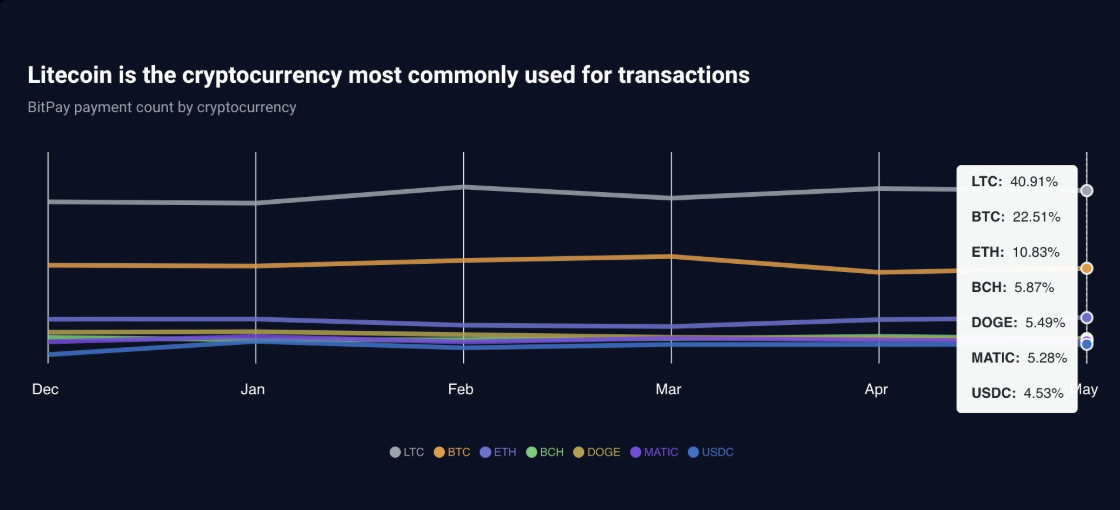
This milestone is so epic as it illuminates Litecoin’s original intent, outlined 15 years ago on BitcoinTalk. To act like a silver to Bitcoin’s gold. And not simply to be exchanged for another currency, but be used for everyday commerce and payments for goods and services.

11. 2022: Litecoin activates privacy via MWEB
Big call, but MWEB is the biggest feature or improvement in Litecoin’s history.
Personal and financial privacy has never been more important. Since May 2022, Litecoin users have had the option of confidential transactions via MWEB (MimbleWimble Extension Blocks). Achieving relative privacy with Litecoin has never been easier.
After years of further development and testing, MWEB was ready for even broader adoption by going mobile. In March 2024 a Litecoin Core release opened the door for mobile wallet support. Integrations by wallets such as Cake and Nexus followed, making private Litecoin transactions far more accessible. Daily MWEB activity grew steadily, with transaction counts reaching highs above 1,600 in late September 2024.
By 16 December 2025, the MWEB balance had reached 402,000 LTC. Continued wallet adoption and rising interest in privacy pushed it even further. As at time of this writing, a balance all-time high of 567,921 LTC was achieved on 11 September 2026.
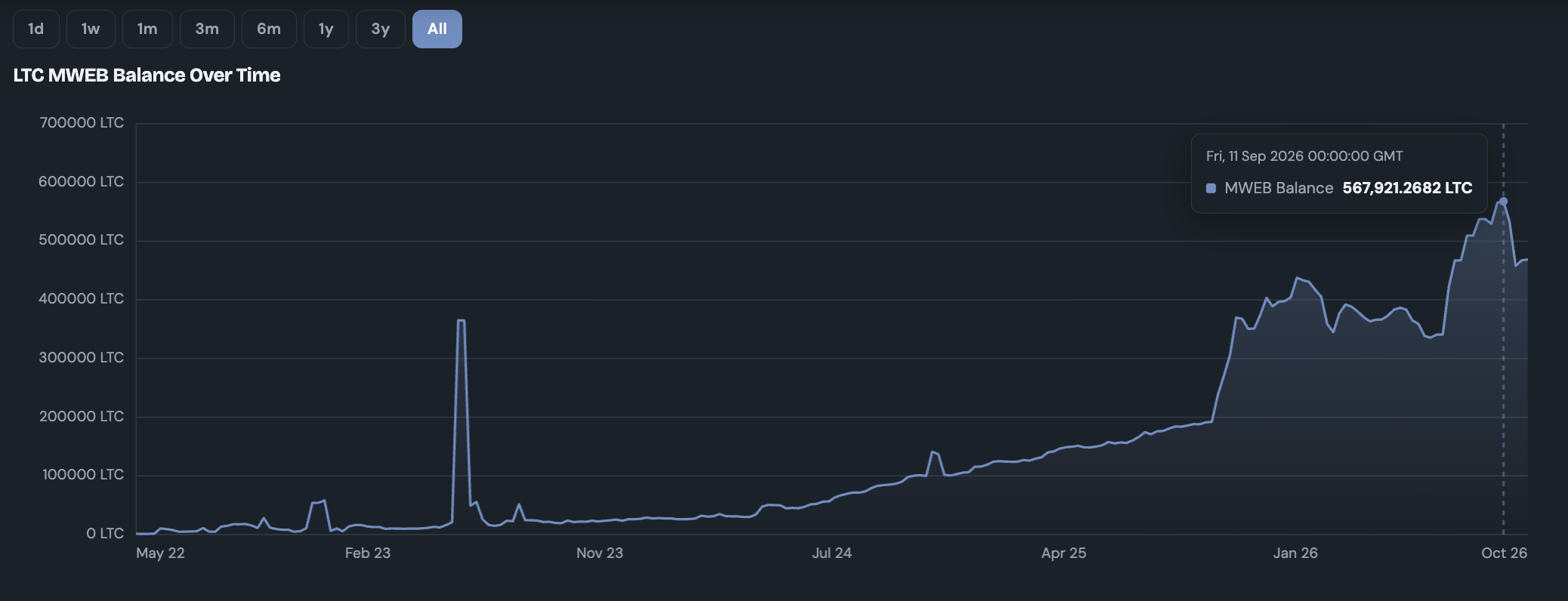
While privacy and “privacy coins” are all the rage across crypto, Litecoin has offered optional confidential transactions since 2022! Making it one of the longest-running and most widely available privacy options in the space. And, importantly, without forcing privacy by default on users. Giving Litecoin greater everyday flexibility than coins that are private by default.
Privacy and Confidential Transactions have been some of the most contentious topics among Bitcoin developers. History has shown that reaching consensus in Bitcoin Core is difficult. From SegWit to Lightning, Litecoin has tested and validated long-debated improvements that were later adopted by Bitcoin. Four years of real-world Litecoin MWEB use may now provide the battle-tested evidence Bitcoin needs to follow suit.
Want to use Litecoin with privacy? It’s super easy. Download Nexus Wallet on iOS or Android - officially endorsed by the Litecoin Foundation.
12. 2025: Litecoin processed 300 millionth transaction
On 4 January 2025, Litecoin processed its 300 millionth transaction! A milestone for permissionless currency, decentralisation, financial freedom and inclusion. But the number becomes more interesting when you look at how Litecoin got there.
In 2024 alone, the Litecoin network processed more than 92 million transactions, up from around 67 million in 2023. Put another way: almost a third of Litecoin’s first 300 million transactions happened in a single year. Thirteen years into its existence, Litecoin had just recorded its busiest year yet.
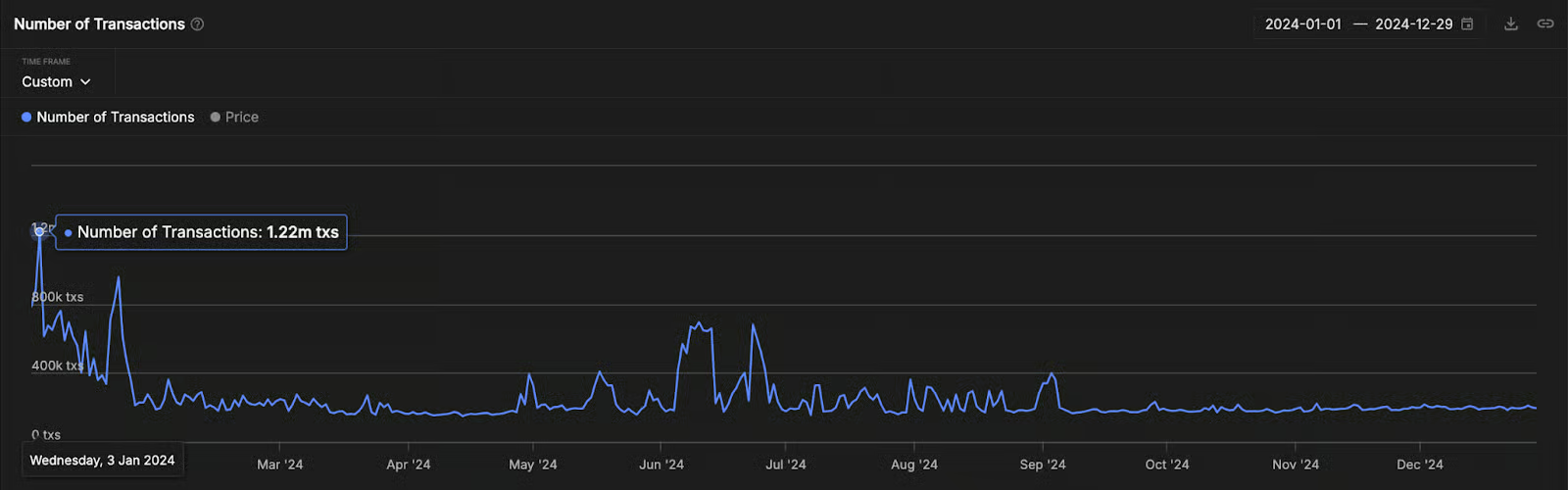
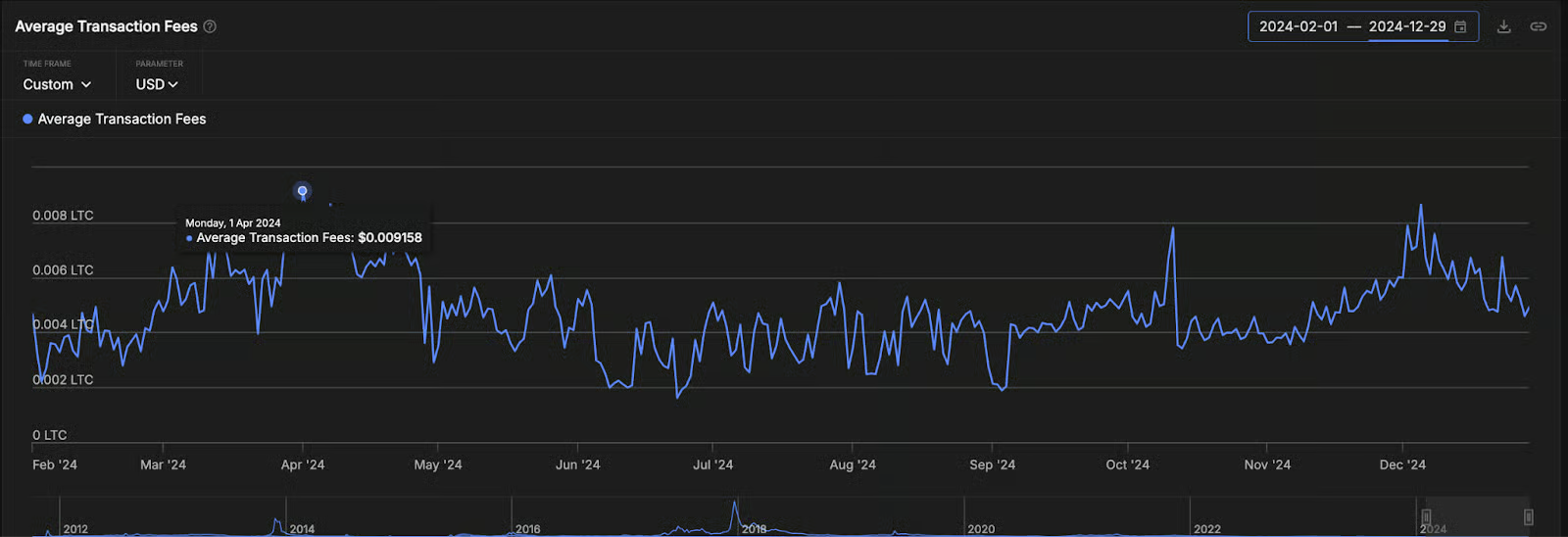
Importantly, all that activity didn’t make Litecoin expensive to use. Throughout 2024, Litecoin’s daily average transaction fee stayed below US$0.01. A fairly important detail for a currency intended for everyday use, not just the occasional movement of a fortune.
Now, Litecoin has passed the 418 million transaction mark. And the count will just keep climbing.
13. 2018-2026: From LoafWallet to Nexus
Countless wallets have added support for Litecoin over the last 15 years. Now, in 2026, almost every major wallet supports Litecoin. Including non-native crypto wallets like PayPal!
Regardless, Litecoin Foundation has always placed considerable focus on developing its own ‘official’ wallet, developed and maintained by its developers. It started with self-custodial LoafWallet, which re-branded to Litewallet in 2019. By mid-2025, the Foundation made the decision to sunset Litewallet in favor of a more robust, reliable and advanced wallet years in the making: Nexus.
Unveiled at Litecoin Summit 2025 by the lead developer, Loshan, Nexus is the new official Litecoin Foundation wallet. Released on iOS and Android in June 2025, Nexus combines self-custody, opt-in MWEB/private payments, Tor integration, Coin Selection, in-app gift card purchase and plenty more.
If you need a Litecoin wallet, check out Nexus. The official Litecoin Foundation wallet. No notes.
14. 2025: Litecoin becomes a corporate treasury asset
In July 2025 we saw the launch of Litecoin’s first corporate treasuries: Luxxfolio and Lite Strategy!
A former Bitcoin miner, Luxxfolio, decided to go all in on Litecoin. Launching in July with a 20,000 LTC treasury. Ever since, Luxxfolio has been committed to helping Litecoin grow, injecting funds into the ecosystem and deploying assets into yield-generating protocols.
Then came Lite Strategy. With more than 929,000 Litecoin, the Nasdaq (NASDAQ: LITS) listed entity is the world’s largest Litecoin Treasury and first US-listed public company to adopt Litecoin as a primary reserve asset. Read all about Lite Strategy’s journey.
Thank you, Luxxfolio and Lite Strategy. We treasure your Litecoin-first passion and commitment!
15. 2025: Litecoin gets its U.S first spot ETF
In November 2025 Litecoin officially joined the ranks of Bitcoin and Ethereum with the approval of its first U.S. Spot Litecoin Exchange-Traded Fund (ETF)! Announced by Canary Capital Group, the NASDAQ-listed LTCC fund represents a landmark moment for the most enduring and reliable crypto.
“In 2011 when I launched Litecoin, my vision was to build a fair, open, and accessible complement to Bitcoin. Fourteen years later, seeing a U.S. spot ETF approved for Litecoin is both humbling and historic. This recognition cements Litecoin’s role as sound money. Fast, secure, and globally accessible." - Litecoin’s creator, Charlie Lee.
-------------------------------
It’s been fifteen years since “a lite version of Bitcoin” launched. And in 2026, Litecoin is still stronger than ever. Not because it followed hype, pumped bags or FOMO’d into the latest narrative. But because it did what other cryptos didn’t: focused on being more usable and useful to people of all walks, all over the world. A mission Litecoin’s had since day one, that’s unlikely to change any time soon.
Happy 15th birthday, Litecoin. Here’s to the next chapter.
Acknowledgments & Dedications.
This piece is dedicated to the champions of Litecoin. Those who’ve made the first 15 years of Litecoin’s life a success. People who’ve asked for no praise, but absolutely deserve it. Every volunteer, community member, donor, event attendee and sponsor; every believer, educator and speaker; and the personalities who make up the Litecoin Foundation’s formidable team.
Ways to support the Litecoin Foundation:
- Donate your support for the Foundation
- Run a node, download Litecoin Core
- Visit Litecoin.com or purchase from the Shop
- Follow @LTCFoundation on X/Twitter
Read other long-form pieces of Litecoin History:
- Bitcoin & Litecoin's 13 Year Symbiotic Relationship
- Deep-dive into Litecoin’s early, early days
- Litecoin’s most prolific year (2023)
- Unprecedented Growth, Memes & Privacy (2024)
- The year Litecoin proved to be sound money (2025)
Written by Robbie Coleman. Follow him on X / Twitter.


